Check-ins and Places

Launched in March 2009, Foursquare has established itself as a top player in location-based services. It allows users to “check in” to a business when they are at (or technically in the vincinity of) a business. In exchange, users earn fancy badges and mayorships, plus social benefits with their friends and other users located nearby. In the short one and a half years of its life, Foursquare has quickly signed up close to 3 million users. Following this surprising enthusiasm from consumers toward such location-based services, Twitter introduced its own location service earlier this year, where Twitter users can attach a location to their tweets. More recently, Facebook also introduced its own location-based service called “Facebook Places”. Through the Facebook iPhone app or mobile web interface (touch.facebook.com), users can check themselves and their friends into locations, and share that information with other Facebook friends.
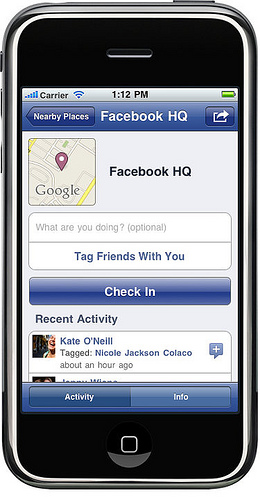
Facebook Places

Photo by Flickr user Anthony Quintano | CC 2.0

Mobile Check-Ins and Loyalty

The fast growth of mobile check-in services has sprung other services that target more specifically at customer loyalty. Some of these services are built on existing mobile platforms such as Foursquare, and others use their own proprietary system. Here I would like to briefly mention three such services as examples of what is taking shape in the field of location-sensitive loyalty. Continue reading “Check-ins and Places”

Loyalty According to Tweeple

A while ago, I created a search column in Tweetdeck to see what people have to say about loyalty on Twitter. To my surprise, once the column was created, tweets just started flying in. There has been rarely a day when I do not see at least a few hundred public tweets containing the word “loyalty”. Apparently, loyalty is on people’s mind often. Out of curiosity, I started to dig a little deeper and more systematically into what is being said about loyalty in these tweets. While I’m not quite done with my analysis yet, here I’d like to share some of my initial discoveries.

What/Whom Are People Loyal to?

When we talk about loyalty, we usually imply an object or person that we are loyal to. From the tweets that I have analyzed, here are the most often objects of loyal passion:

  • A romantic relationship or partners in the romantic relationship
  • Friends and family
  • Sports team
  • Brands/products
  • Co-workers/boss
  • Dogs’ loyalty to their owners (such as this touching story from Wikipedia about this Hachiko dog)

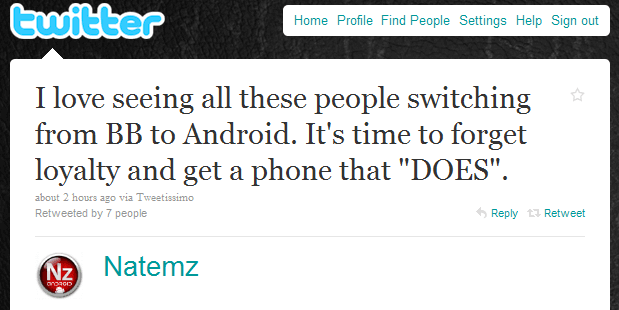
Interestingly, when specific brands or products were mentioned as objects of loyalty, mobile products such as cellphones and mobile providers were the most frequently referred-to product category. For instance, earlier today, there were a few retweets of the message by @Natemz below.

Loyalty Tweet

In this case, the tweet is actually a counter-loyalty message, where product features beat loyalty. But it still implies loyalty that some people used to have for BlackBerry before they switched to Android. Continue reading “Loyalty According to Tweeple”

The New Rich in China

As I stood at a busy intersection on People’s Avenue South in Chengdu, China, I am dazzled by the high-end designer labels I see. Louis Vutton, Dior, MaxMara, and many other luxury brands all opened up shop here. With the fast economic development during the last decade, there has arisen a new class of rich Chinese consumers who spend their money generously on these luxury goods.

 yacht
Photo by Flickr user yachtfan | CC 2.0

Of course, those who can afford to buy luxury brands are still far and few in between. According to the World Bank, 1% of Chinese families now possess 41.4% of China’s wealth. This represents a bigger gap than that of the United States, whose corresponding number is 5% families owning 60% of national wealth. The Gini coefficient, an index used to measure income inequality, has also surpassed the warning level of 40 in China ten years ago to reach 47 today. Continue reading “The New Rich in China”